
Sewer smell in the basement: the real causes and how to get rid of it
A sewer smell in the basement indicates that a barrier has failed somewhere between your wastewater drainage system and the air you breathe. In a well-built home, sewer gas stays inside the pipes. Every P-trap holds a water seal that blocks the passage, and the vent stack carries fumes out above the roof. When it smells like rotten eggs in the basement, one of these two mechanisms has failed. The question is which one, and what to do next.
The 5 key points
- A dried-out floor drain trap is the number one cause, especially in Quebec homes where this drain is rarely used.
- Sewer gas contains hydrogen sulfide, a toxic and flammable gas. Your nose is not a reliable instrument for assessing the danger.
- Pouring two liters of water into every floor drain solves most problems in less than twenty minutes.
- If the smell returns after rain or during extreme cold, look elsewhere : a clogged pipe, a stuck backwater valve, or a frozen vent stack.
- Chemical products and air fresheners mask the symptom and damage your pipes. They do not fix any of the six underlying causes.
Where is that rotten egg smell coming from?
What sewer gas contains
The sewer gas is a mixture produced by the decomposition of organic matter in the drainage system. It contains hydrogen sulfide, methane, ammonia, and carbon dioxide, among others. Hydrogen sulfide is responsible for the rotten egg signature, which the human nose can detect at tiny concentrations. The Canadian Centre for Occupational Health and Safety is categorical on one point: this gas has very poor warning properties, and you should never rely on your sense of smell to judge exposure. At high concentrations, it completely paralyzes your sense of smell, which creates the false impression that the problem has been resolved. Methane, on the other hand, is flammable. In a closed basement where the odor is strong and persistent, ventilate the area and get out before looking for the source.
Why the basement is always affected first
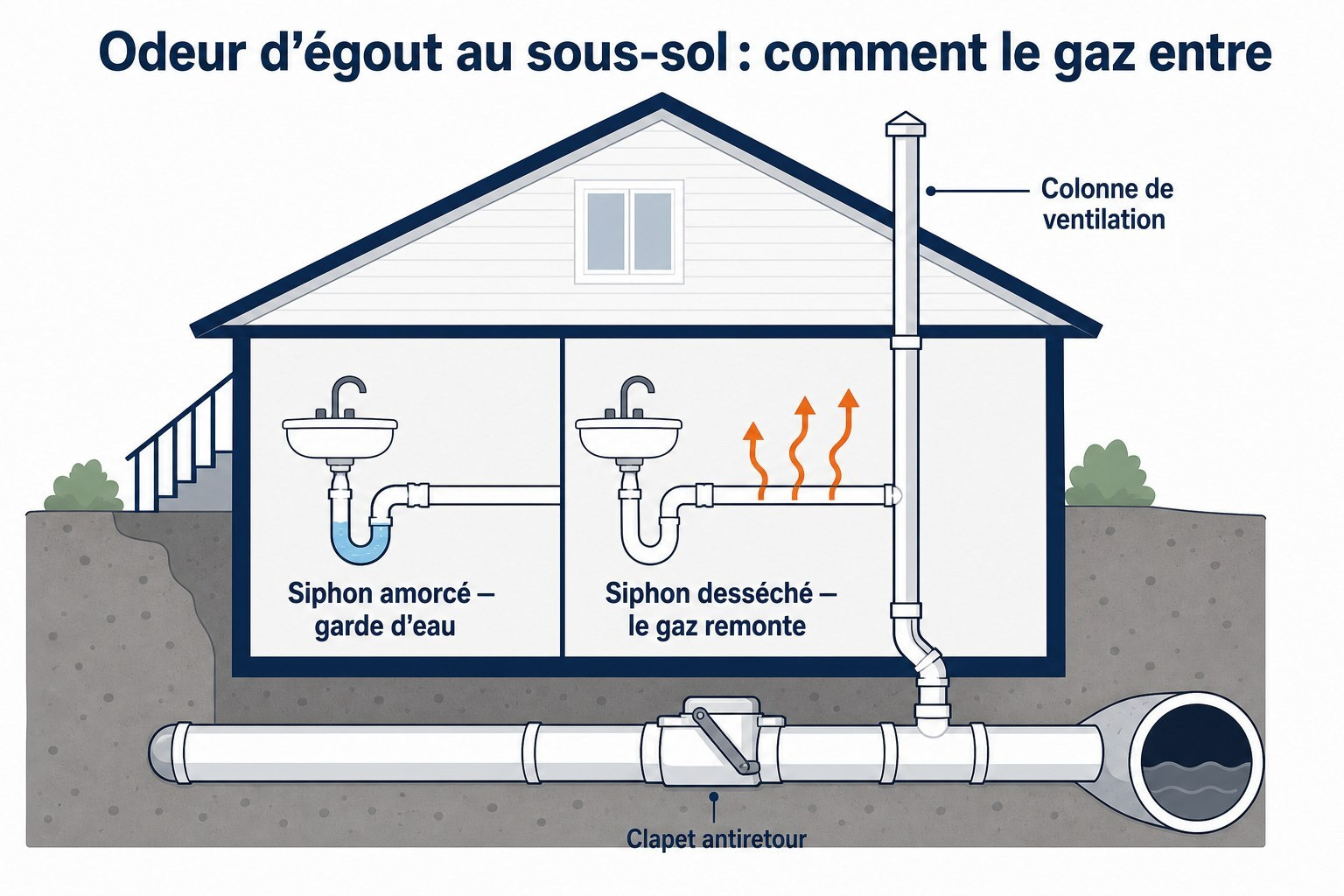
The basement is the lowest point in the entire drainage system. It contains the floor drain, the sump pit, the washing machine drain, the main connection, and often the backwater valve. Pressure variations in the pipes push the gas toward the first weak point it finds. In Quebec, this weak point is almost always the floor drain that is never used.
The 6 possible causes, from most to least frequent
1. A dried-out floor drain trap
Every floor drain is equipped with a U-shaped trap that always holds a small amount of water. This water seal acts as a plug that prevents gas from coming back up. The National Plumbing Code of Canada requires a water seal depth of at least 38 mm, and at least 100 mm for a deep-seal trap. This 2020 edition, as amended by Quebec, constitutes Chapter III, Plumbing, of the Construction Code in effect since July 2024.
A drain that never receives water will see its reserve evaporate in a few weeks. Even faster if the basement is heated and dry, or if a ventilation register blows directly over it. The trap is then empty, and the house is connected directly to the sewer. By far the most common scenario, and the easiest to fix.
2. A clogged, frozen, or improperly terminated vent stack
The The drainage system breathes through a vent stack that exits onto the roof. It vents fumes and balances pressure so that the water in the traps is not siphoned out. A nest, leaves, or frost are enough to clog it. The pressure then causes the water seals to siphon, and the gas looks for another exit. It finds it in your basement.
In Quebec, frozen roof vents are a classic issue in January and February. Chapter III of the Construction Code requires that every trap be protected by a vent pipe, and the Régie du bâtiment du Québec specifies how this roof vent must be sized. When the odor appears during extreme cold or high winds, then disappears during a thaw, the clue is reliable.
3. A partially clogged drain or pipe
A partial blockage traps organic matter that ferments in place. The odor becomes constant and is often accompanied by slow drainage, gurgling in a nearby fixture, or water backing up into the floor drain when the washing machine empties. Roots, grease, and debris buildup in the main drain are the usual culprits, and drain cleaning remains the only lasting solution. Deodorizing does nothing here. You must clear the blockage. Our guide on how to unclog a drain details the methods based on the type of blockage.
4. A faulty or stuck backwater valve
This device prevents municipal sewage from backing up into your home. When its flap gets stuck open by debris, it lets air and odors through, while also exposing your basement to a backup.
Chapter III of the Construction Code sets out specific requirements for backflow protection, and the Régie du bâtiment notes that a backwater valve is the recognized method to achieve this. It also highlights that sewage and rainwater backups are among the most frequent causes of home insurance claims. The City of Montreal also makes it a cornerstone of backflow prevention.
A backwater valve does not maintain itself. Its installation, inspection, and replacement are a specialized plumbing service, and our article on what every homeowner needs to know about backwater valves explains what to look for.
5. A cracked seal, fitting, or drain pipe
A poorly sealed toilet in a basement bathroom, a dried-out wax ring, a loose fitting under a utility sink, a leaking shower drain, or a crack in aging cast-iron drain pipes. Each of these defects creates a permanent air leak. The odor remains localized, stronger near a specific fixture, and does not change with the weather or usage.
This is also the scenario where a damp, musty smell overlaps with sewer odors, sometimes accompanied by stains on the walls, because a water leak often accompanies the air leak.
6. A damaged sewer connection or a septic tank issue
If none of the first five causes explain the odor, the problem is likely underneath. A collapsed, cracked, or root-invaded sewer line allows fumes to seep through foundation walls and floors without coming from an identifiable fixture, making the source invisible without an inspection.
In a home not connected to the municipal sewer system, the septic tank and its leaching field become additional suspects. A full tank, a clogged vent, or a saturated field. These cases require excavation and sewer line replacement, not DIY work.
Diagnosis: Finding the source in 5 steps
Step 1: Prime all traps
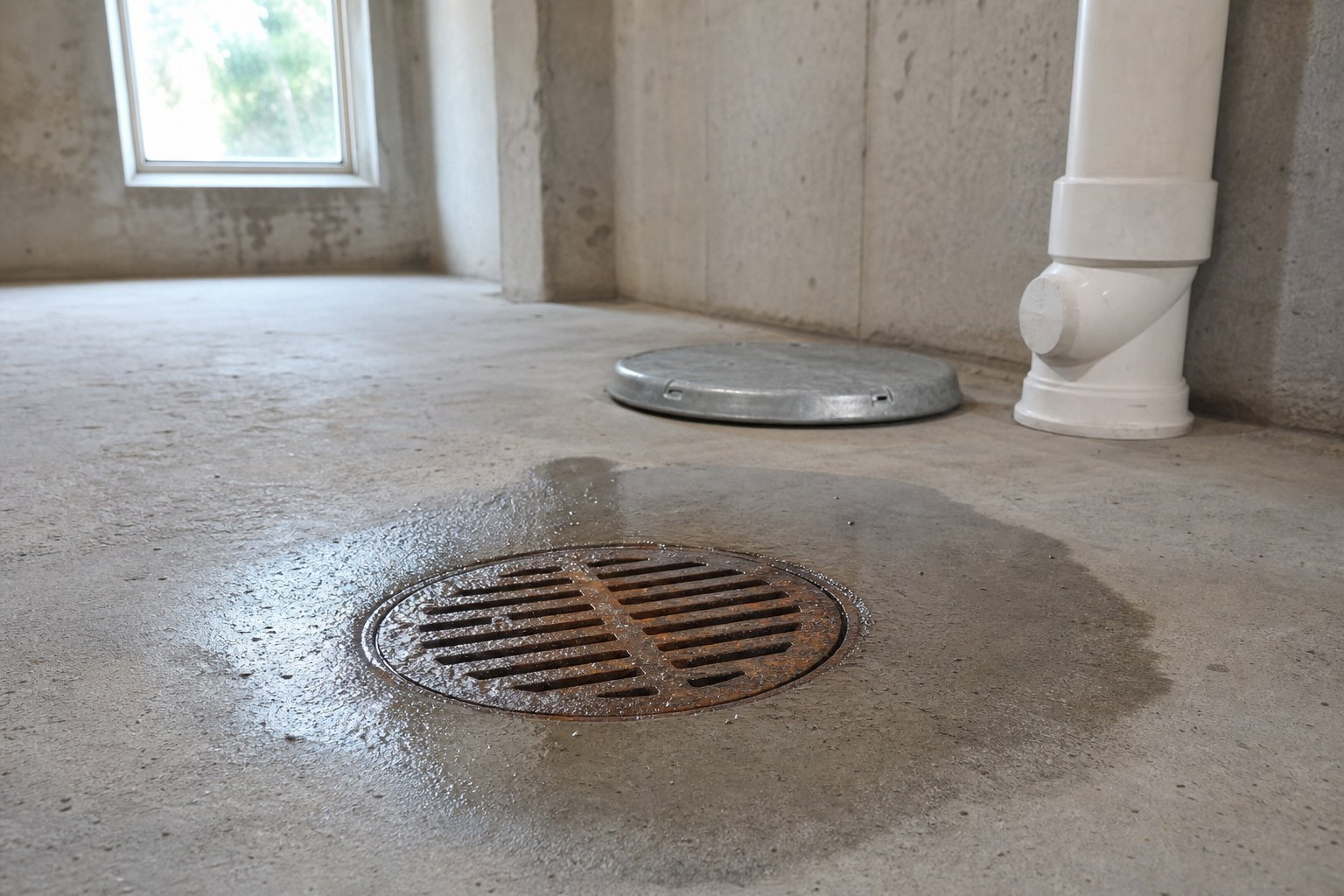
Pour two liters of water into every floor drain, including those in the garage or mechanical room, then run water for thirty seconds in every rarely used drain. Wait twenty-four hours. If everything returns to normal, the cause was a dried-out trap and you have just fixed it.
Step 2: Locate the odor fixture by fixture
Sniff at floor level near every drain, the base of the toilet, the washing machine connection, and the sump pit cover. A spot that is significantly stronger than others points to a faulty seal rather than the entire system.
Step 3: Note the conditions under which the odor returns
During extreme cold or high winds, consider ventilation. After heavy rain or a thaw, consider the backwater valve and the municipal system. If it is constant, consider a partial blockage or an air leak. This correlation between conditions and the odor is the most useful information you can give a plumber, and you are the only person who can provide it.
Step 4: Inspect the backwater valve and sump pit
Remove the backwater valve access cover, check that the flap moves freely, and ensure no debris is blocking it. If you do not know where it is, or if the access point is difficult to reach, stop there.
Step 5: Smoke test and camera inspection
When the source remains elusive, the plumber injects non-toxic tracer smoke into the drainage system. It will emerge exactly where the leak is. A camera inspection of the main drain completes the picture, revealing cracks, collapses, and roots. These two tests eliminate guesswork instead of digging blindly, and they pinpoint the exact origin before any major work is done.
Eliminating the problem, cause by cause
What you can do today
- Prime every trap with two liters of water, then repeat every month.
- Clean the floor drain grate and remove any debris accumulated underneath.
- Tighten any visibly loose trap connection under a utility sink.
- Ventilate the basement and check that the mechanical ventilation, such as an HRV or air exchanger, hasn't simply been turned off.
- Clear the roof vent if it is visibly obstructed and can be accessed safely.
What requires a licensed plumber
Main drain cleaning, replacing a basement toilet seal, repairing or installing a backwater valve, thawing or extending a vent stack, smoke testing, camera inspections, and any work on the sewer connection must be performed by a licensed contractor.
In Quebec, plumbing work requires a contractor's license including sub-category 15.5, Plumbing Contractor, issued by the CMMTQ as a government agent. As a homeowner, you must ensure that you only entrust this work to a licensed contractor. The reason is both practical and legal. Improper work on a drainage system can cause siphoning and move the problem elsewhere in the house, which essentially means paying twice for the same issue.
What you should never do
Do not pour bleach or chemical drain cleaners into a smelly drain. Chlorine reacts with the sulfur compounds in sewer gas, and caustic products attack seals and cast iron without actually dissolving the blockage.
Do not seal a floor drain with silicone or a permanent plug, because you are cutting off the basement's emergency drainage and moving the problem instead of fixing it.
As for air fresheners, they only mask the odor while the leak continues from letting gas in.
Preventing the problem from returning
Seasonal maintenance of traps and drains
A litre or two once a month in each floor drain is enough to keep the water seals full. Add this task to your spring and fall routine, along with inspecting the backwater valve and cleaning the grates. In a very dry basement or a home left vacant for the winter, a deep-seal trap or a trap primer installed by a plumber solves the problem at the source, with no monthly maintenance required.
Winter protection for ventilation and plumbing systems
Before the deep freeze, check that the roof vent is clear. Keep the basement heated, insulate exposed pipes, and shut off outdoor water supplies. A dry basement smells less musty and handles temperature fluctuations better. These same steps protect against frozen plumbing and the siphoning of water seals. A weeping tile system and a sump pit in good working order provide complete protection against moisture and sewage backups.
When to call for emergency service
Call immediately if the smell is strong and sudden, if it is accompanied by headaches, nausea, or eye irritation, if wastewater is backing up through the floor drain, or if nothing changes after priming all the traps and waiting twenty-four hours.
A persistent odor indicates an active leak in a system that carries toxic and flammable gases. This is not something to leave unaddressed all winter.
FAQ
Still smelling something? Get a professional diagnosis
Plomberial diagnoses and fixes sewer odors in Laval, the North Shore, and Greater Montreal: source localization, smoke testing, camera inspection, drain cleaning, backwater valve repair, and sewer line replacement. Our emergency service is available 24 hours a day, 7 days a week.
Contact us and let us know when the smell occurs. You will have completed half the diagnosis before we even arrive.
Get a free quote