How to tell if your water service line is made of lead: tests, map, and next steps
You are in the basement, standing in front of the pipe coming through the foundation wall, and the house was built before 1970. Here is how to tell if the pipe is made of lead: use a combination of three checks (the age of the building, a visual inspection of the pipe, and water testing).
Key points
- Homes with eight units or fewer built before 1970 are the most likely to have a lead water service line.
- Four simple tests can be done in the basement: check for a grey colour, no metallic sound when tapped, a shiny mark when scratched, and no reaction to a magnet.
- Only a water test can confirm the presence of lead, because the underground portion may be lead even if the visible section is copper.
- The standard is 5 µg/L in drinking water in Quebec as of March 2021.
- In Montreal, the private lead service line must be replaced by the property owner, in accordance with Bylaw 20-030.
Is your home at risk?
The risk depends primarily on the age of the building. According to a study by the City of Montreal, buildings with eight units or fewer built before 1970 are the most likely candidates. Buildings with more than eight units do not have lead service lines, according to Montreal Public Health.
The service line is the pipe that brings water from the street into your building. According to Québec.ca They were primarily installed between 1940 and 1955, and continued to be used until the 1970s. The National Plumbing Code has prohibited them since 1980. Since 1989, it has also prohibited solder containing more than 0.2% lead.
In 2019, the City estimated that there were still approximately 50,000 lead service lines within its territory. Sixteen of the nineteen boroughs are affected. The risk is very low in L'Île-Bizard-Sainte-Geneviève, Pierrefonds-Roxboro, and Saint-Léonard.
Finding the right pipe in the basement
Look for the shut-off valve, which is the valve that turns off the water for the entire building. It is generally located near the foundation wall on the street side, often close to the water meter. The pipe entering the house at this location is the one to examine.
If you cannot see it, contact your landlord or a plumber. Pipes may be hidden behind a partition or casing.
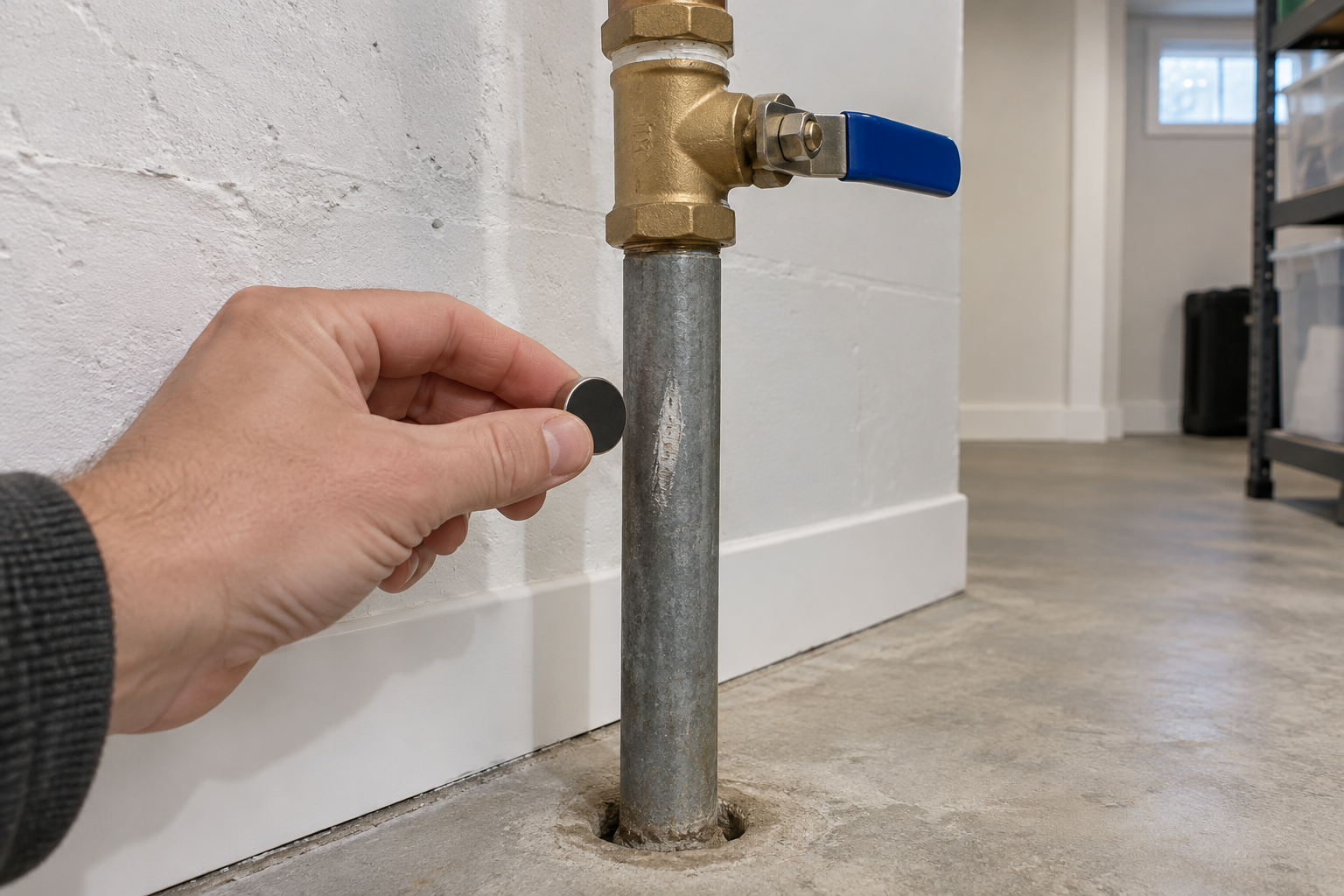
The pipe coming out of the floor near the shut-off valve is the one to examine.
The four tests you can do yourself
These checks are recommended by the City of Montreal. They can be done without any special tools and without dismantling anything.
The first test is for colour. A lead pipe is dull grey. The second is for sound. Tap the pipe gently with a wrench: lead does not ring and produces a dull thud.
The third is for scratching. Using a small knife, gently scrape the visible part, without piercing or putting pressure on the fittings. Lead is a soft metal, and the surface will become shiny and silver, with metallic marks. The fourth is for a magnet: it will not stick to lead.
If all four signs match, the pipe is very likely made of lead. A negative result does not rule it out, because an underground section may be made of lead even if the visible entry point is a different metal. Only a water analysis can confirm it.
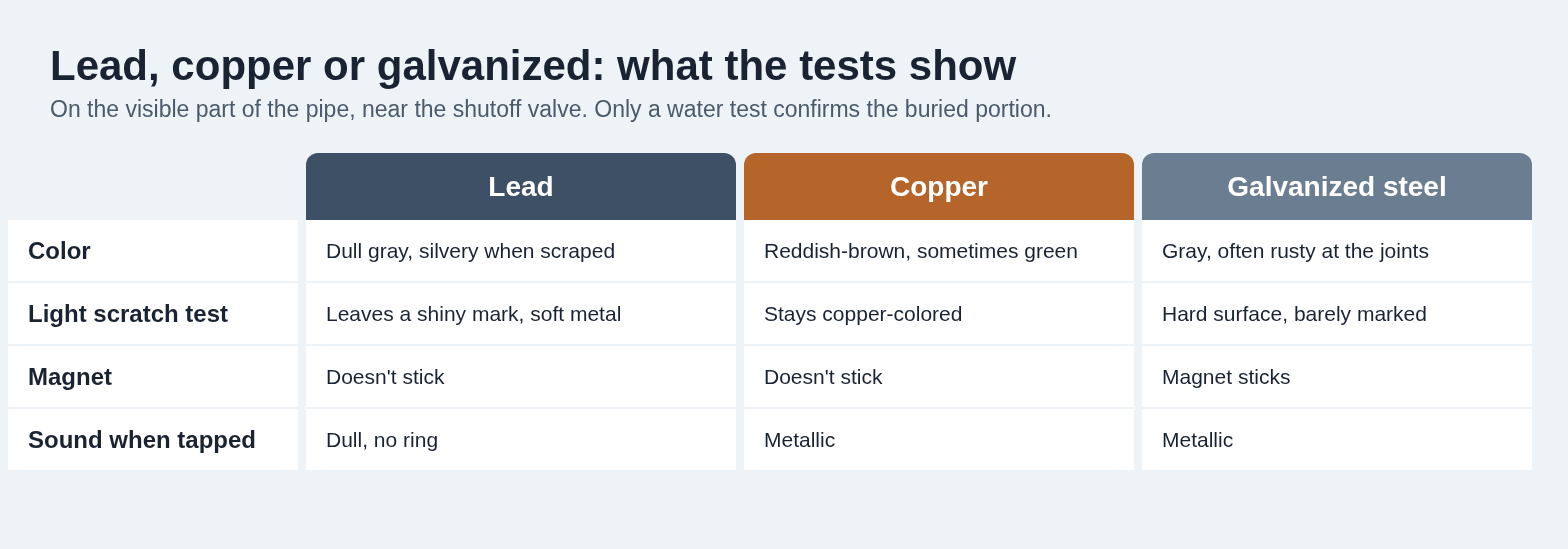
What the tests on the visible part of the pipe show.
Lead, copper, or galvanized steel: how to tell the difference
Copper is reddish-brown, sometimes covered in a greenish patina. It is hard, rings when tapped, and does not scratch easily. Galvanized steel, which is steel coated in zinc, is also grey, but a magnet will stick to it. Plastic is easily identified by touch.
Corroded galvanized steel pipes can reduce water flow. If this is your situation, our article on low water pressure explains the causes.
Lead can also be found elsewhere in interior plumbing: in solder, faucets, and fixtures. These elements generally pose less of a lead exposure risk than a lead water service line.
Consult the Montreal map and request testing from the City
The interactive map of lead water service lines works by address. It indicates three statuses: potential lead, lead, or no lead. For buildings that have not yet been tested, it is based on the year of construction and the number of units.
The City also offers in-home testing. A clearly identified representative measures the lead concentration in your kitchen tap water using a portable instrument (Palintest). The program runs from June to October, and you will receive a notice in advance. You can request testing without waiting for this notice. This testing does not replace regulatory analysis by an accredited laboratory.
In Laval, the City has been systematically replacing or rehabilitating the public section of service lines known to be made of lead since 2007. If the private section is also made of lead, the City provides support to the resident. If only the private section is lead, they send a letter recommending its replacement. Elsewhere on the North Shore, check with your municipality, which is responsible for complying with lead standards in its water distribution system.
Have your tap water tested
An analysis by an accredited laboratory provides the definitive result. The standard is 5 µg/L, set in March 2021 by the Drinking Water Quality Regulation, in accordance with Health Canada's recommendation.
The sample takes into account water that has been sitting in the pipes. The laboratory will provide you with instructions for taking the sample. The result of municipal testing remains a quick indicator, not a regulatory analysis.
Lead in water: who is most at risk?
Exposure to lead from drinking water is generally low. Children under 6 years old Infants and pregnant women (for the unborn child) are more sensitive. For any health questions or blood tests, call Info-Santé 811 or consult your doctor.
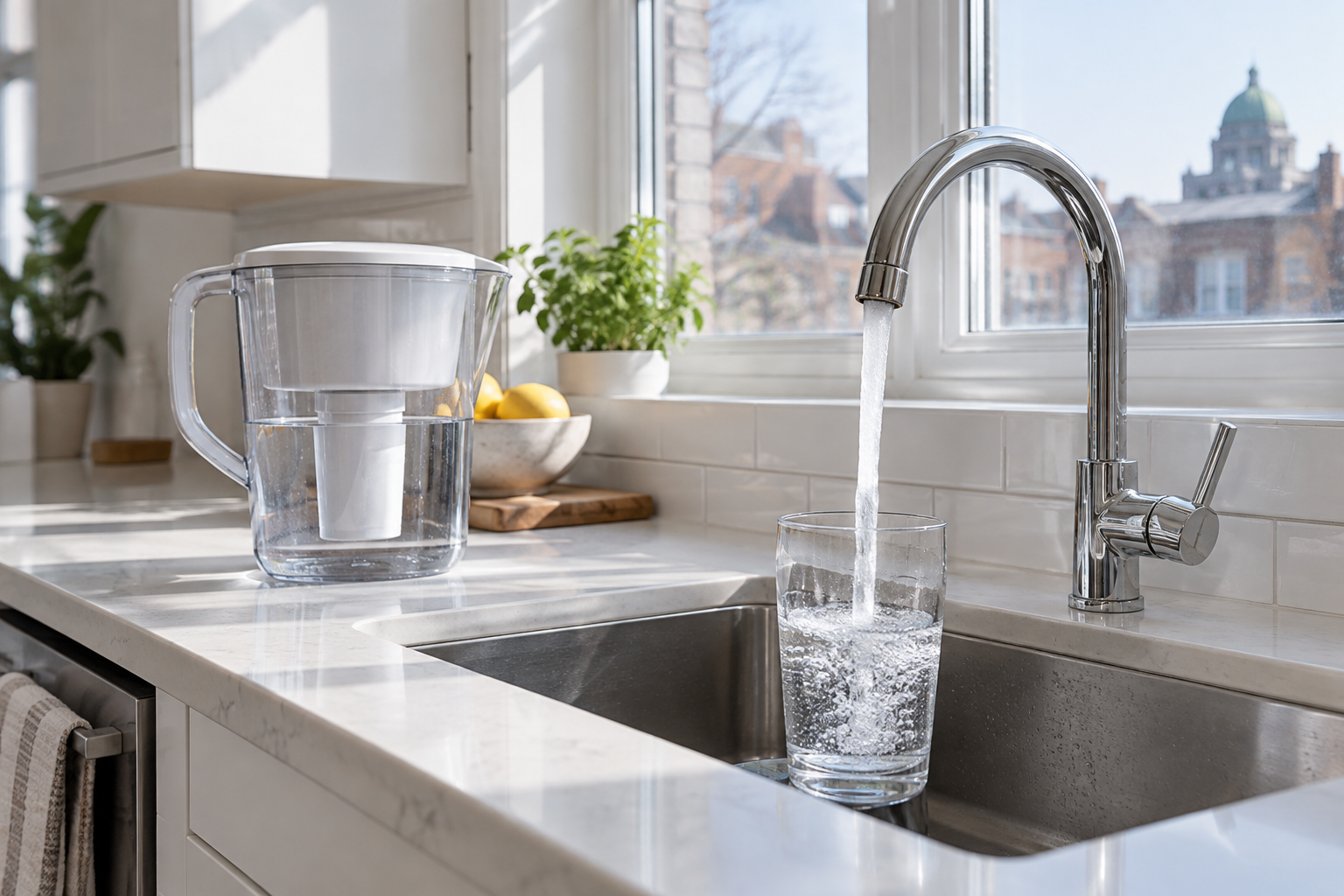
Use cold water for drinking and cooking, and a certified filter while waiting for the replacement.
While waiting for replacement: steps to reduce exposure
Replacement remains the most effective and lasting solution. In the meantime, some steps can help, according to Québec.ca:
- Let the water run until it is cold, then for a few more minutes, in the morning and when you return from work.
- Use cold water for cooking, drinks, and infant formula, as hot water contains more lead.
- Clean the faucet aerator.
- Choose a pitcher or filter certified NSF/ANSI 53 for lead reduction, and change the cartridges regularly.
- Do not boil the water: lead does not evaporate and its concentration can increase.
To filter water for the entire kitchen while waiting for the work to be done, you can also install a water filtration system under the sink. The filter reduces exposure for at-risk individuals, but it does not replace the lead pipe.
Public section, private section: who pays for what?
The public section runs from the water main to the property line. In Montreal, the City replaces it at no cost, most often during water main or road work. The private section runs from the property line to the indoor shut-off valve. It belongs to the property owner.
Since 2021, the By-law 20-030 makes it mandatory to replace the private lead section. You must do so within the 24 months following the notice of non-compliance. Fines range from $500 to $2,000 for individuals and from $1,000 to $4,000 for corporations.
The City estimated the average cost, based on 2022 to 2025 data, at between $1,200 and $1,400 per linear metre replaced. The invoice is sent the year following the work. You can pay it in a lump sum or over 15 years. The City also publishes available financial assistance: check the amounts at the source at the time of the work.
You may carry out the work before the City intervenes, using the contractor of your choice, after obtaining the necessary permits from your borough office. The City recommends getting quotes from three contractors. Our guide on choosing a plumber with an RBQ licence can help you. Depending on the site, the project may require excavation. The water service line replacement must be performed by a plumber with an RBQ licence. After the replacement, declare the material to the City by providing the invoice or photos.
For details on our intervention, visit the water service line replacement.
Frequently asked questions about lead pipes
Not sure? Give us a call, and we'll assess the situation. Request your free estimate.
Get a free quote